| Pictures on Flickr can be found here: Central of Peru Railway https://www.flickr.com/photos/colinchurcher/albums/72157607077711507 Cerro de Pasco Railway https://www.flickr.com/photos/colinchurcher/albums/72157607089841645 Cusco to Machu Picchu https://www.flickr.com/photos/colinchurcher/albums/72157607081685807 Huancayo to Huancavalica https://www.flickr.com/photos/colinchurcher/albums/72157607089804765 Peru General https://www.flickr.com/photos/colinchurcher/albums/72157607074066554 Bolivia General https://www.flickr.com/photos/colinchurcher/albums/72157607096879567 Bolivia Railway https://www.flickr.com/photos/colinchurcher/albums/72157607096879577/
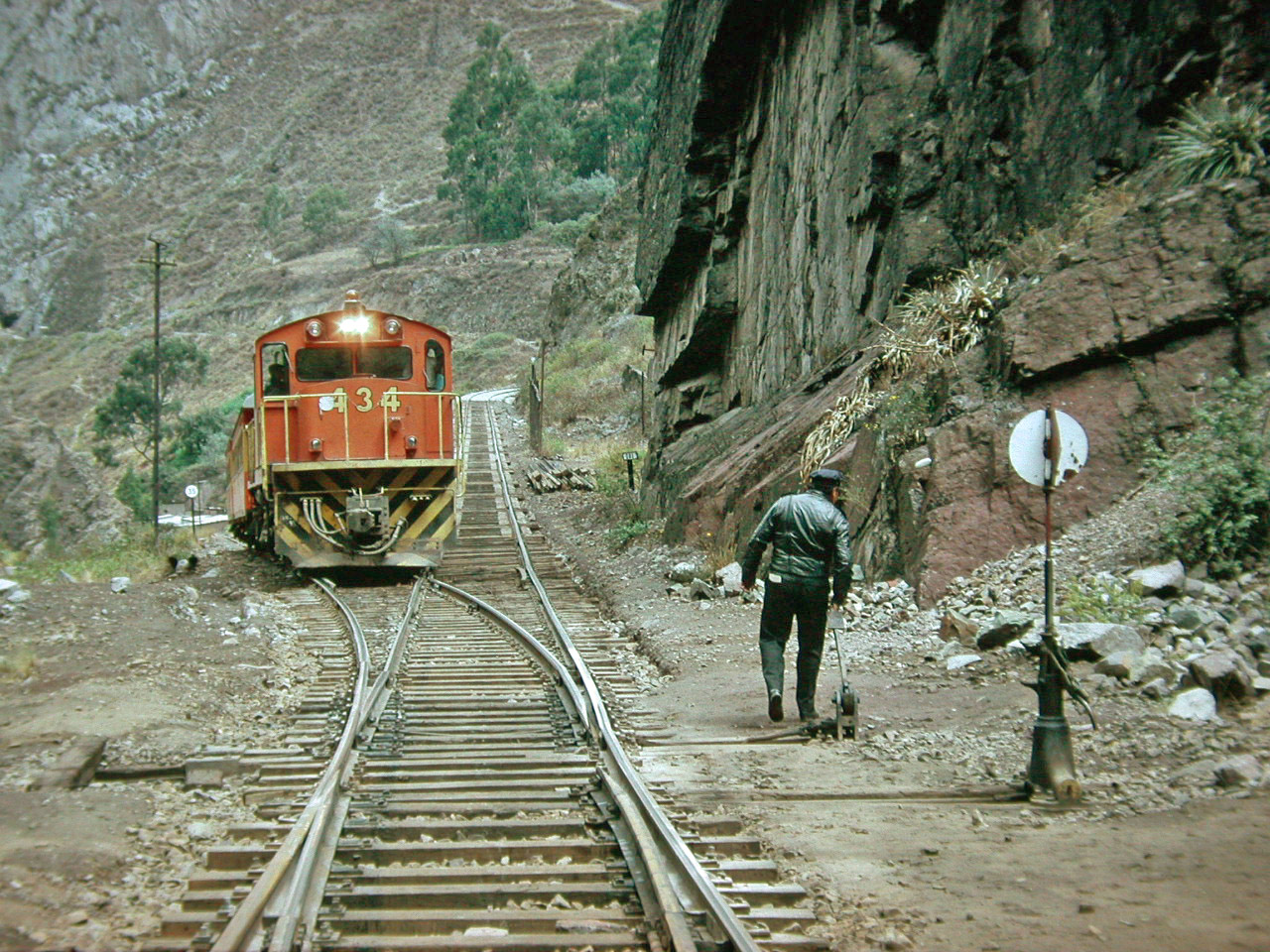
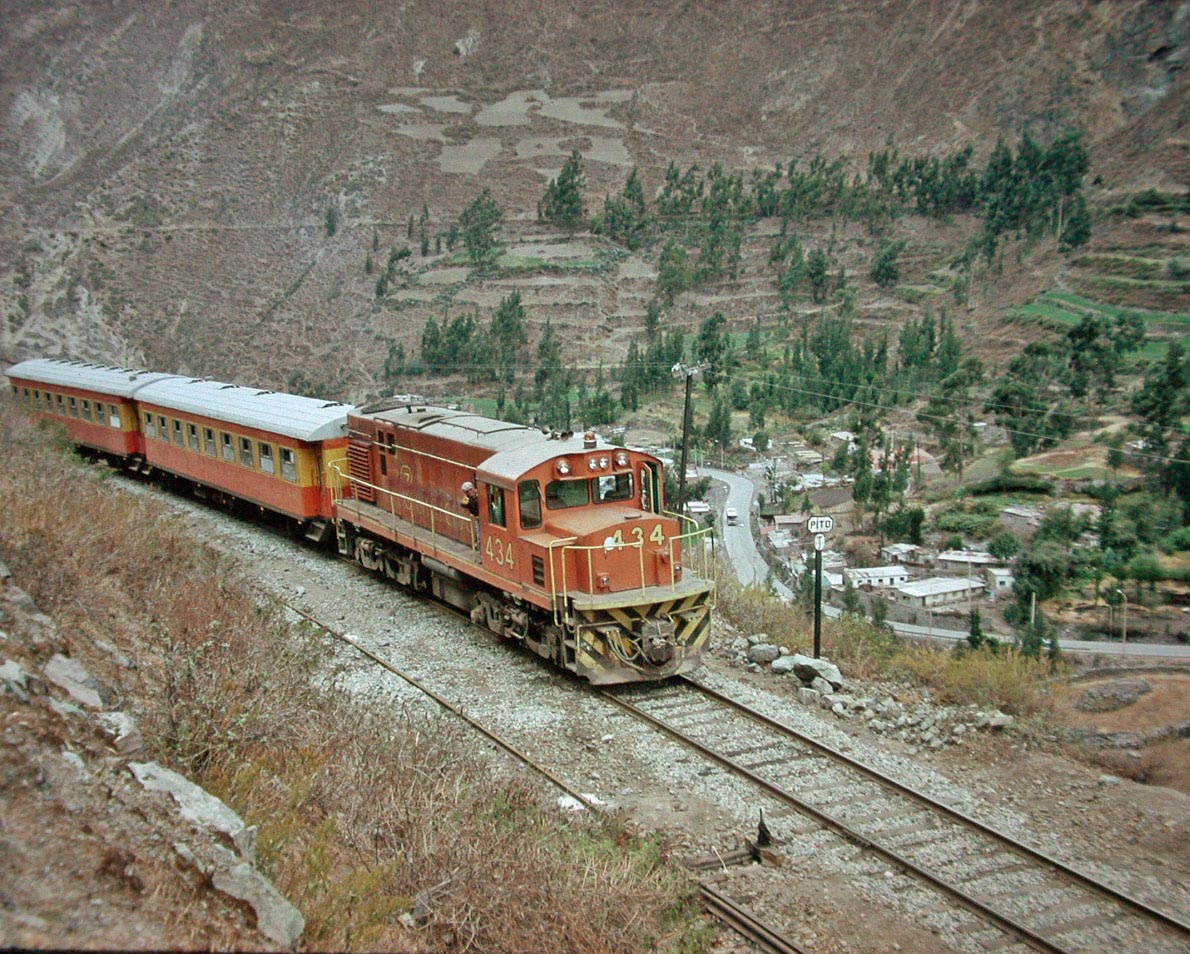
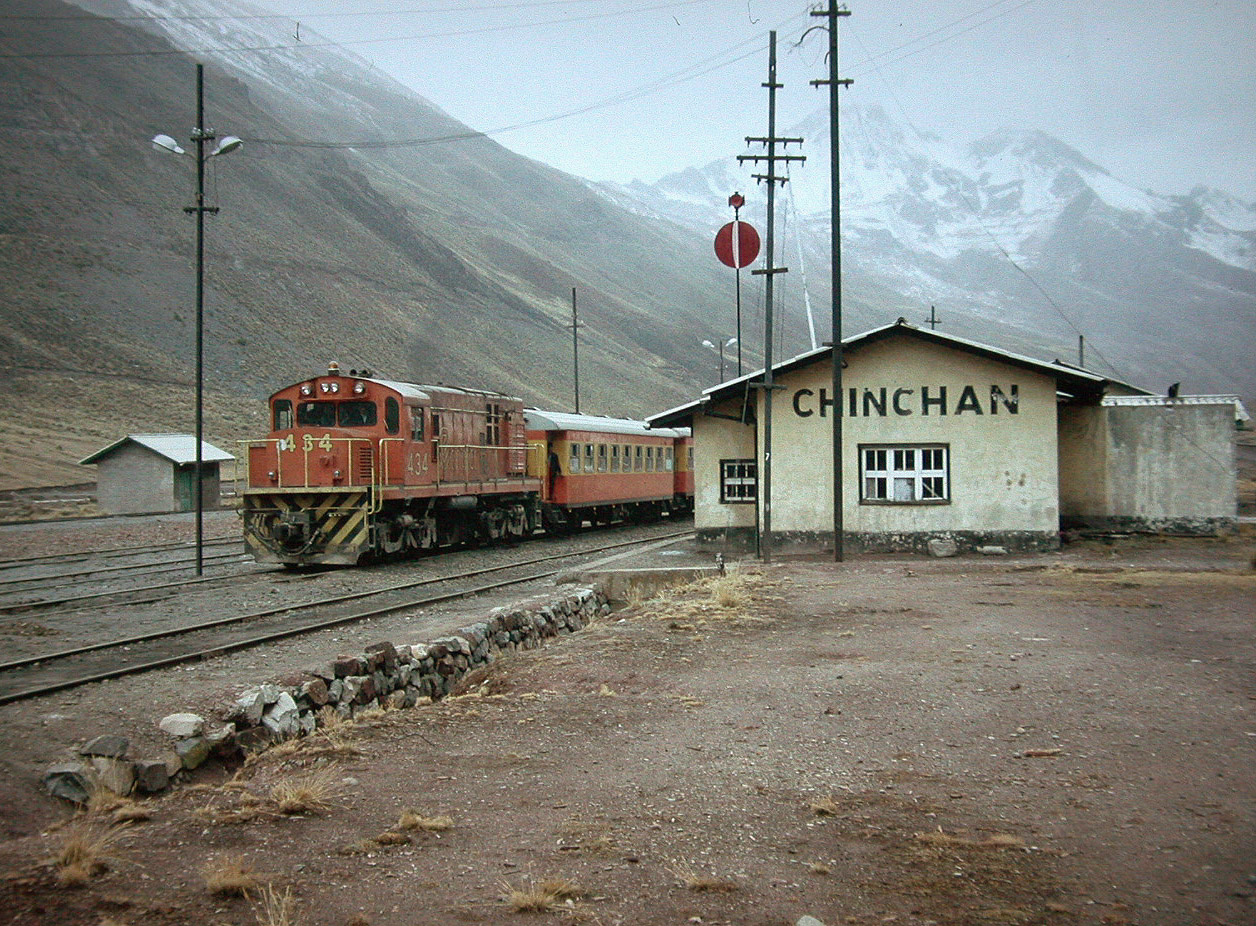
Thursday 7 August 1997- Lima to Huancayo Let the adventure begin! We were up early and taken by bus a couple of blocks to the presidential palace. The station is close by but we had to walk the rest of the way because of security reasons. One does not question these decisions, especially when we were the only ones seemingly not carrying guns. There was a good welcome for us at the station and much confusion as to how to get the baggage into the train. Eventually some of the bags were put in a small bus which followed the train. Passenger train service over the main line between Lima and Huancayo was discontinued in 1987 as a result of attacks by the Shining Path (Sendero Luminoso) terrorist group which blew up a couple of trains - the locomotives being destroyed as they plunged into the valley below. Our train was the first passenger train since 1987. We were made very welcome and there were several people recording our presence with video for the benefit of the tourism trade. It is difficult to see a great deal of the coastal plain because of the mist but the line climbs right from the start so that by Choisica (km 54) which is 40 km from Lima (Callao is km 0) we had climbed to 2,821 ft at an average grade of 2.79% (the steepest main line grade in Canada is now less than 2%) We had #434, built in Montreal, on the front. These have a reputation for sounding awful but taking a lot of punishment. We were accompanied by several armed policeman, a nurse with an oxygen bottle and our delightful local guide, Carmen. Carmen told us a great deal about the customs of the area and helped me to understand a little of the Peruvian psyche. As we climbed out of the coastal murk she explained the differences between the lowland and the highland people's. It seems one day a team of lowlanders were building a road and were being watched by a highland indian. The indian was fascinated and absorbed everything that was going on. After some time one of the engineers came up to him and remarked that he seemed very interested in what was going on and asked him how they built a road in the mountains. "Well, señor, we get a donkey to walk along the route until the road is made” “Really, and what if you can't find a donkey? “ “Then, señor we use an engineer”
Climbing
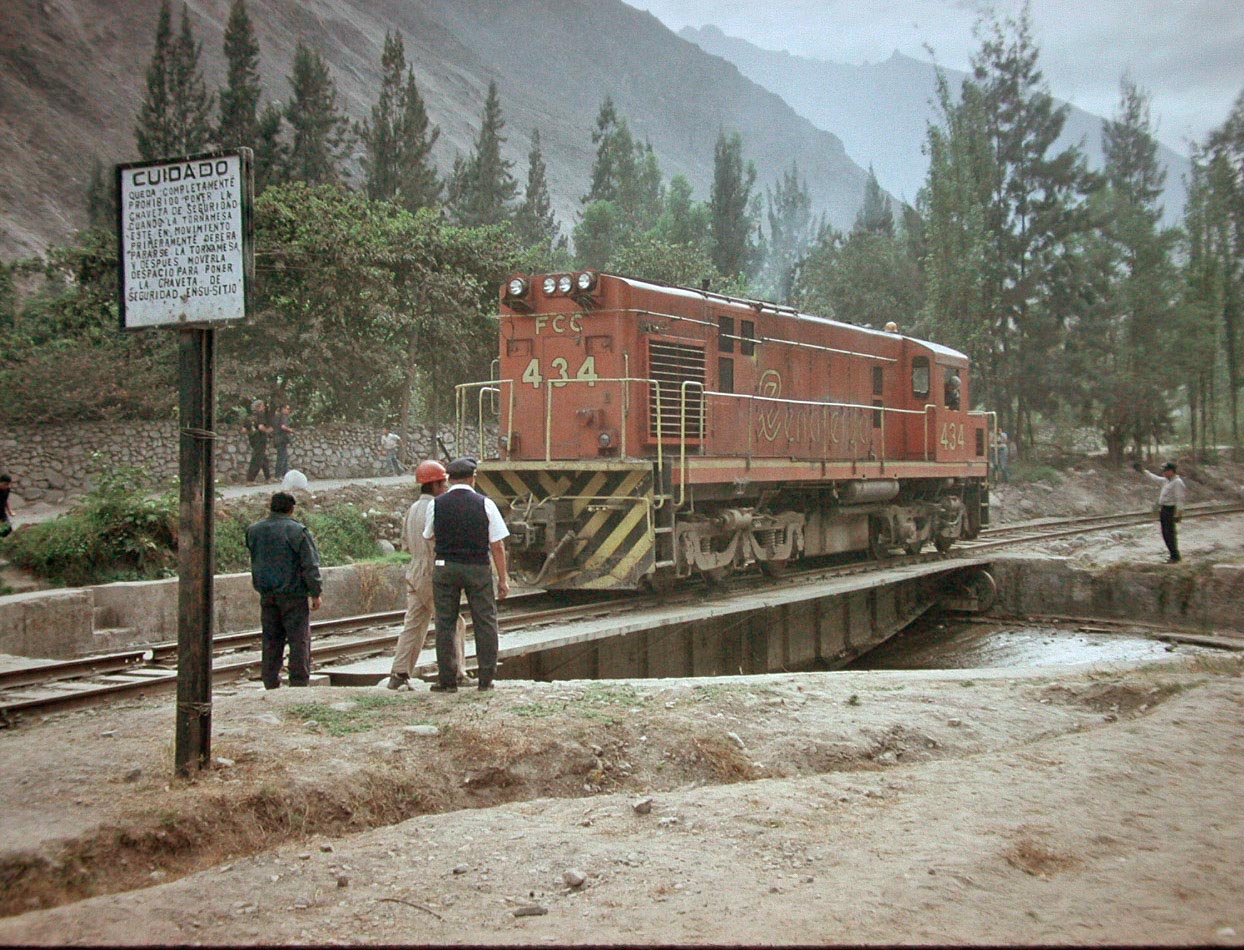
a 4.10% grade, we reached San Bartolome (km 76.0) at 08:35. The air is
cooler here and less humid. The locomotive was detached, turned on a
turntable, and attached to the other end of the train.
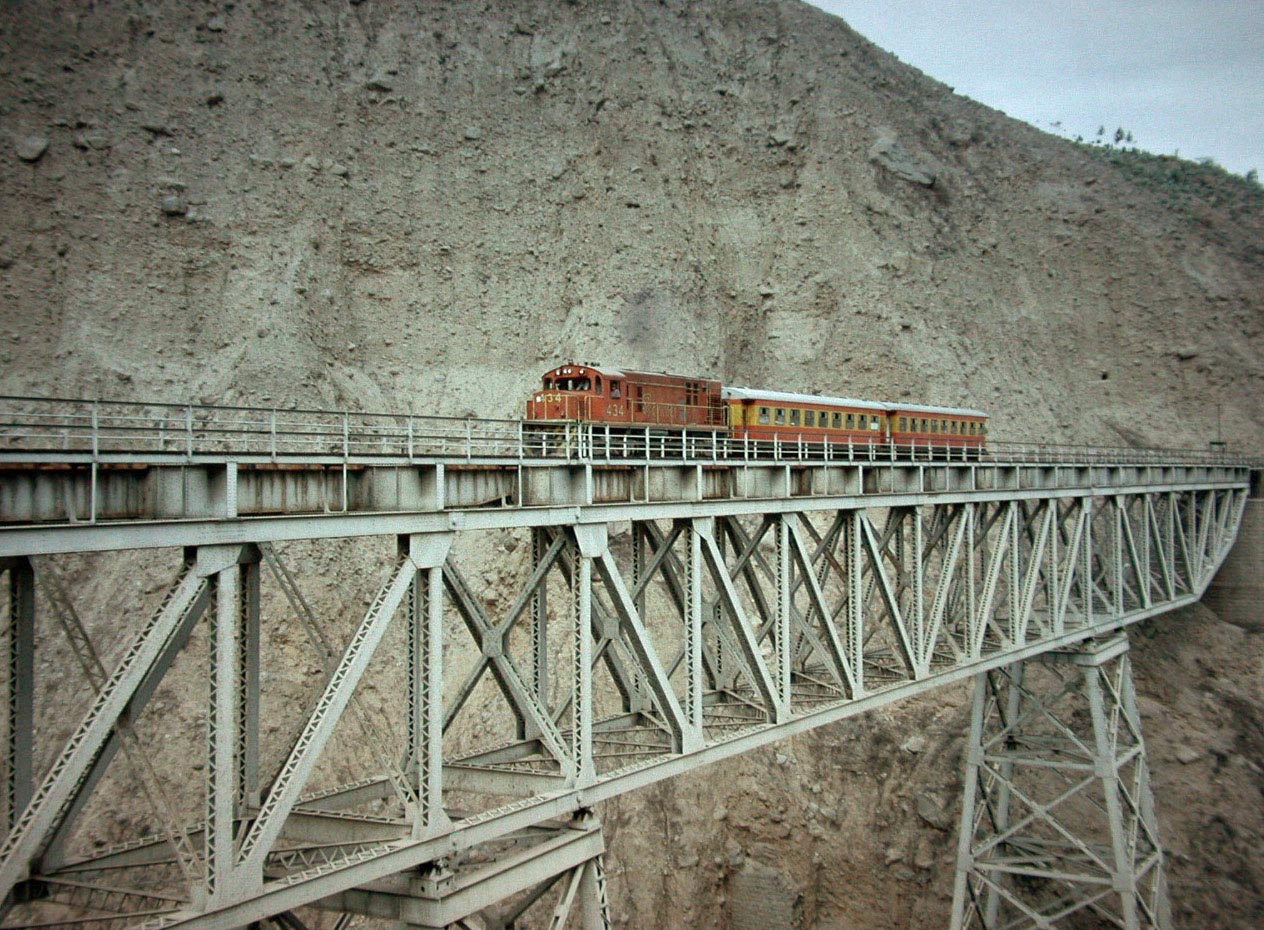
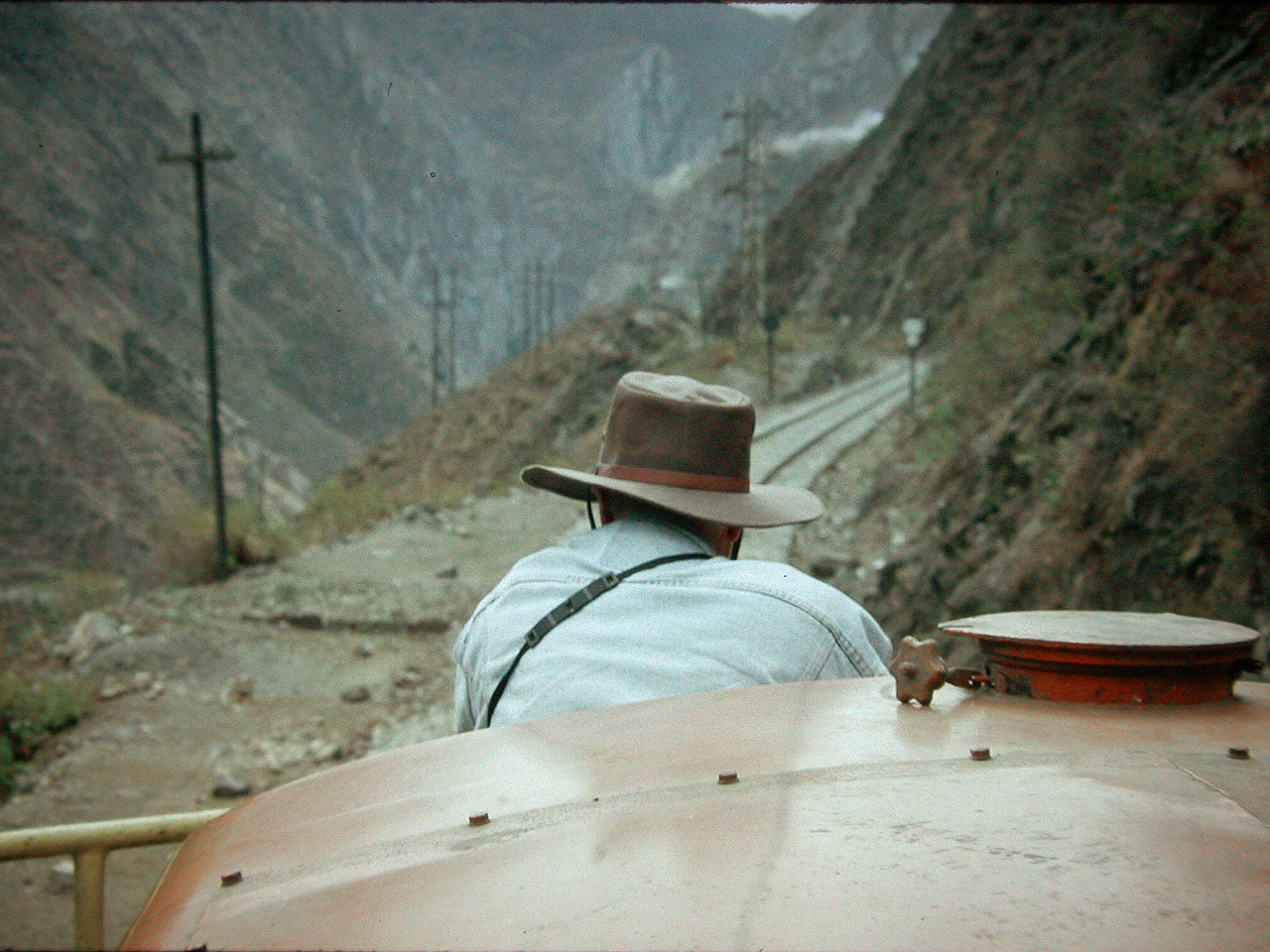
It is here the serious climbing begins starting off with a horseshoe curve through fields of cactus which is used for dye (cochinilla). It is difficult to describe the mountains without using superlatives. We were climbing up the valley of the Rimac river with vast panoramas, terrifying drops, stupendous bridges, clinging to cliffs, gut wrenching, white knuckle etc. The American engineer who built the line, Henry Meiggs, had to exercise a great deal of ingenuity to find a line through the mountains. He used a great number of loops as well as switchbacks where the train ends in a dead end valley, reverses up the side of the valley and then changes direction again so that the train has now gained several hundred feet. I rode in the cab for one of these and was impressed at how quickly they could be traversed. Before the train had completely stopped the brakeman had jumped off and thrown the switch so the engineer could give the backup whistle (three blasts) before the train had completely stopped. We then backed up at full throttle, sometimes for several kilometers, into the second switchback and were ready to go ahead as soon as the train had stopped. In some cases in order to gain sufficient length for the train the tail of the switchback is extended into a short, dead end tunnel. It was comforting to note additional braking systems in use, dynamic and independent brakes on the engine and automatic and straight air brake on the train. The latter is additional to normal and explains the two brake pipes fitted to all trains.
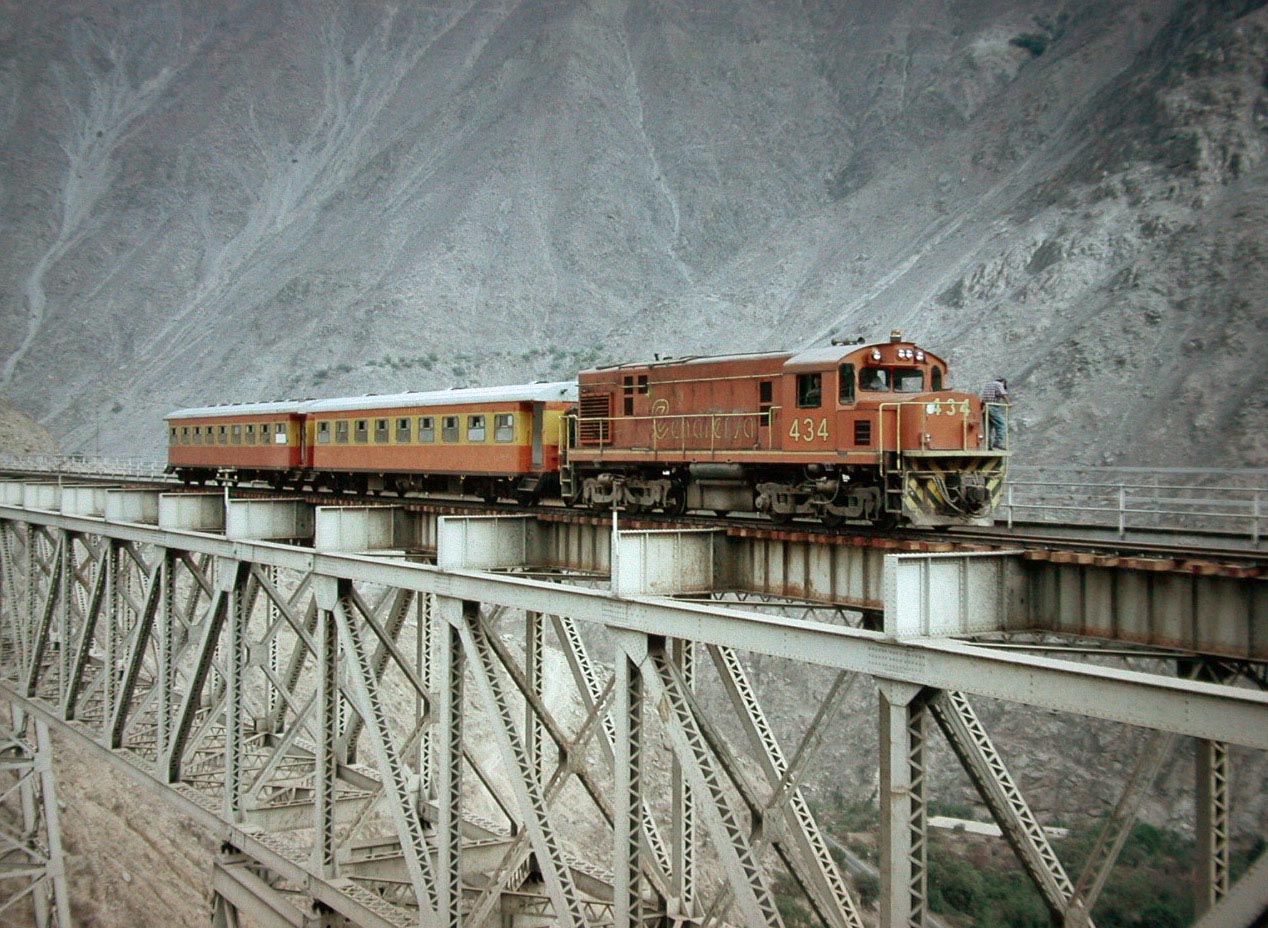
Puente
Carrion was named after a local doctor who did research into a local
disease which was killing many local people. It was a form of malaria.
He infected himself and died of the disease. We stopped for a photo run by at the Puents Carrion bridge (km 84.89). Those on the outside of the photo line had to be careful because there was an incredible drop to the valley below. There are vast curves at Surco, partly hidden in tunnel. It was difficult to maintain a sense of direction because of the curves, tunnels and switchbacks - good job we had a map. There was a stop for orders at Matacana (km 103) at 7,841 ft and we passed a down train near the switchback at Viso where a kestrel was using a telegraph pole as a perch. The eucalyptus tree has gained a firm holding in the valley and provides valuable wood. There are many wild llama in the area.
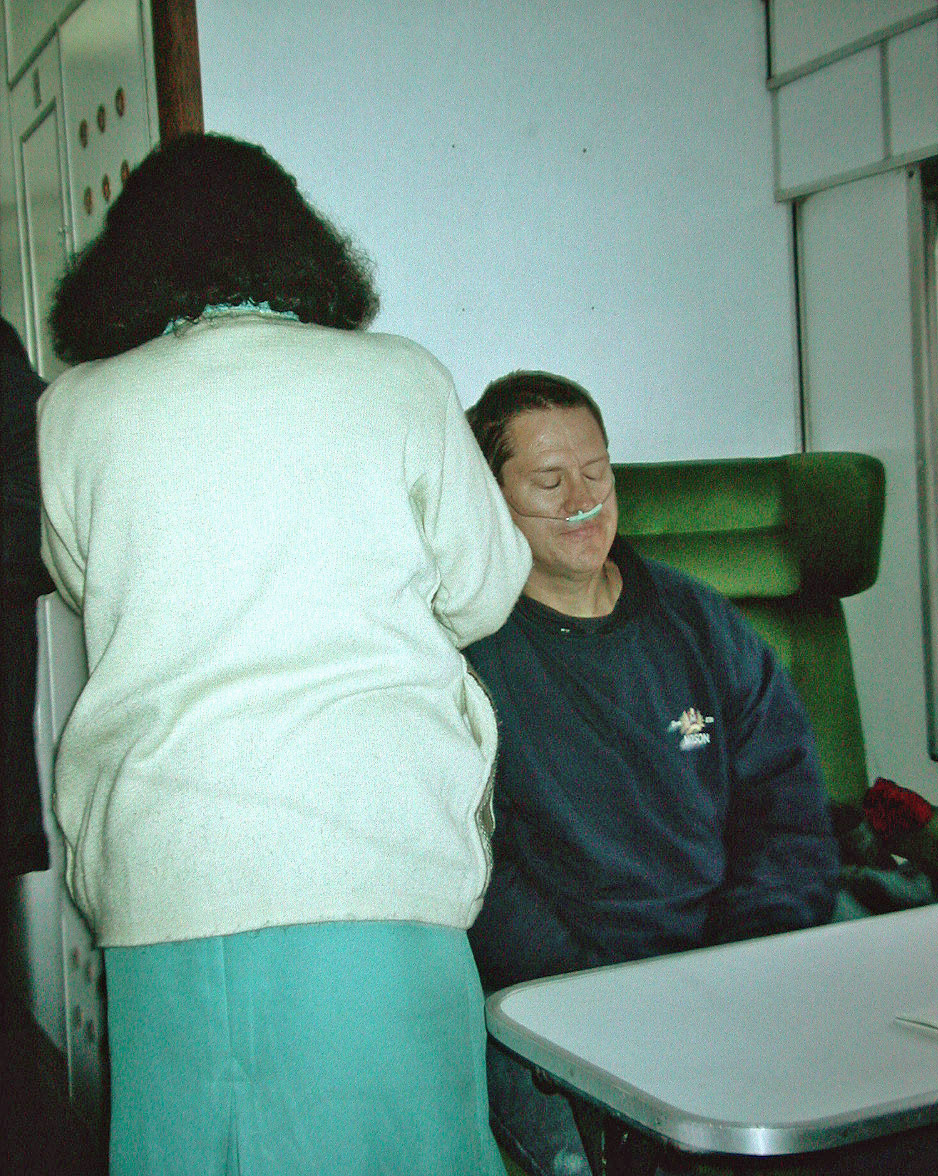
Visio One of the group collapsed as he was trying to board the train at Tamboraque (km 120) at 9,871 ft. The nurse soon brought him around with a whiff of oxygen. We had just started off when another member of the group was violently sick. Again, the oxygen did the trick. It was about then that I realized that the oxygen bottle is no joke as I began to feel the effects of the altitude myself. I had a mild headache and was breathless. Was I to be next? It was now lunch time. It was served by smartly dressed waiters in white shirts and black ties. The fried egg, ham and cheese sandwiches were washed down with mineral water con gaz and followed by coca mate which is supposed to be good for altitude sickness. Coca mate is made from coca leaves although I think one's bladder would give up before one felt the effect of the cocaine (it is illegal in the USA). The nurse was continually patrolling the cars giving us all a deep scrutiny.
Casapalca
Chinchan
Casapalca is at 13,600 feet and I began to feel better with some food in my stomach. Maybe I was feeling faint from lack of food rather than lack of oxygen. The mountains were covered with wet snow and it was overcast. At Chinchan (km153) we reached a wide, high valley and stopped for a run past. We had just started again when the brakes went on hard in emergency. We stopped just short of some large rocks between the rails. Our thoughts turned immediately to the Shining Path and everyone was ready to dive for cover as the crew got down to remove the obstruction. The police fingered their automatic weapons. It turned out to be a boring rock slide and after much work to clear the track we were able to proceed. In the valley below we could see a truck which had turned over near a hairpin bend.
A short stop at Ticlio and as we entered the Galera tunnel I dashed for the toilet and peed onto the tracks. The tunnel at 15,688 ft, is the highest point on the line and is the watershed between the Pacific and the Atlantic so that my water would make its way into both oceans. With a silly grin on my face I returned to my seat as we broke out into daylight and stopped at Galera (15,681 ft ). It was difficult to make out my emotions. This is the highest main line railway in the world and there is only one higher (narrow gauge branch) line. (subsequently superceded by the Chinese in Tibet).I have dreamed about making this trip for nearly 50 years - ever since I was old enough to be trusted to look at my father's cigarette card collection- Railway Wonders of the World.
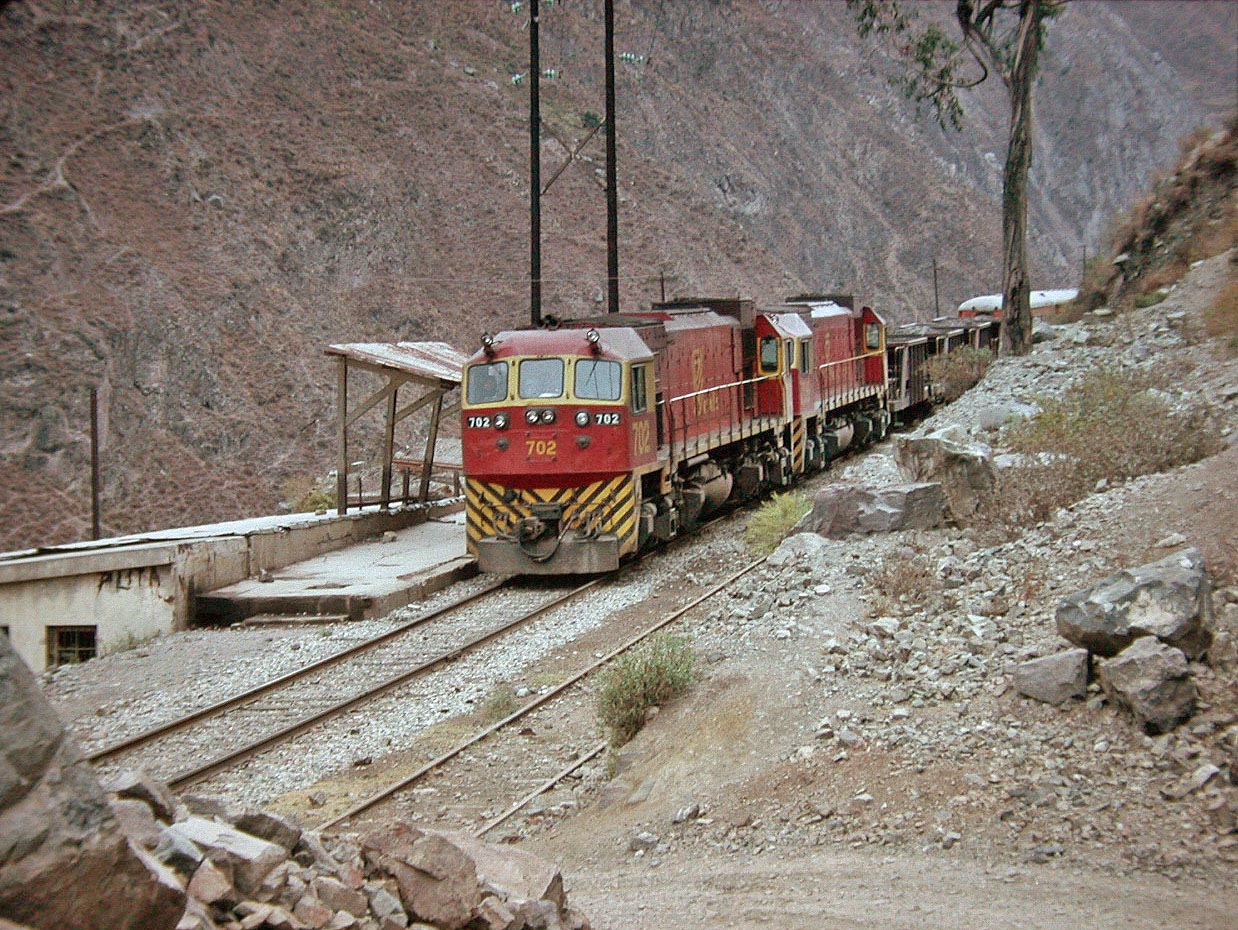
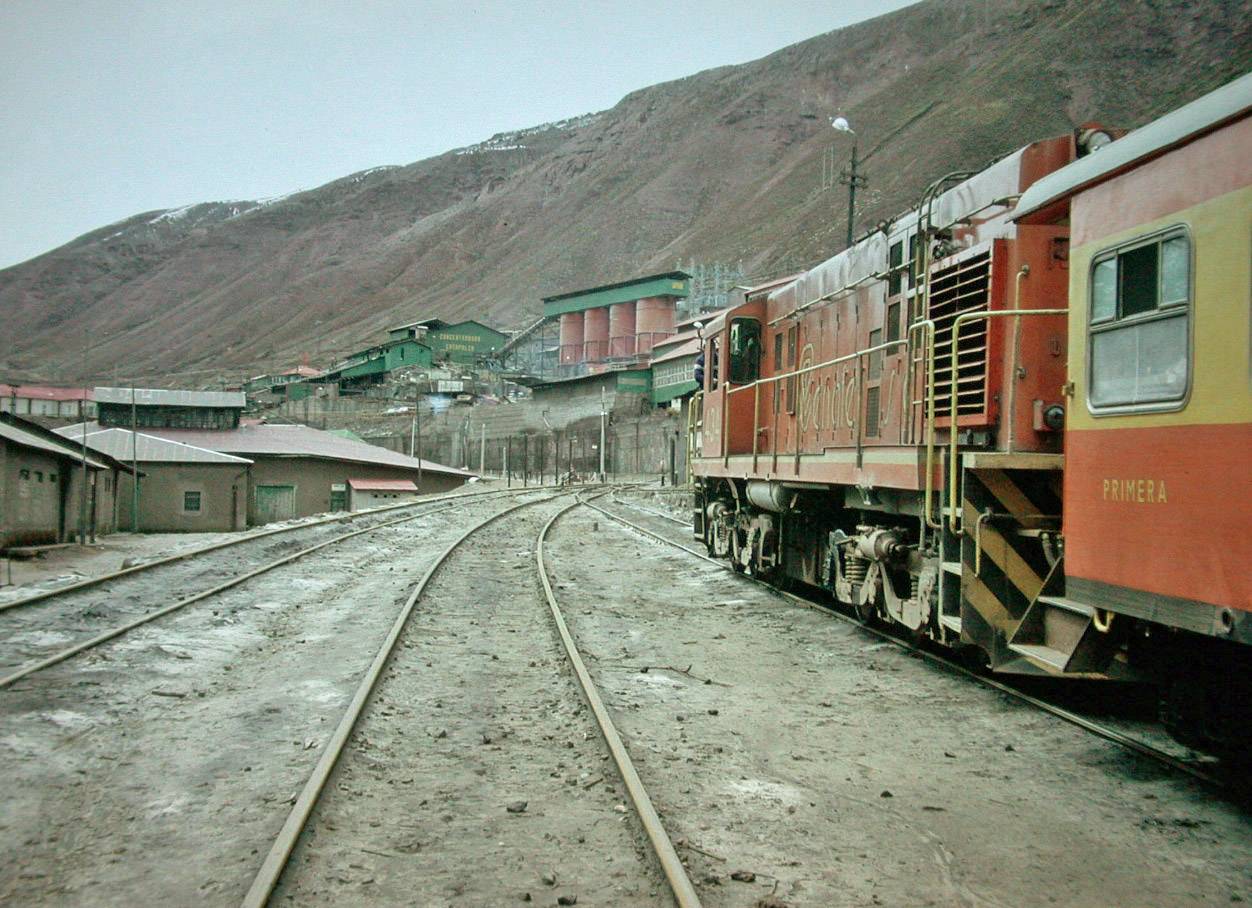
Galera As we dropped down towards La Oroya we could see increasing signs of mining activity. Some of the streams were a nasty brown color, out houses were constructed over streams and cars were abandoned in most unlikely places. La Oroya is a mining town with cliffs towering all around. The restaurant car staff tried to earn some money by charging over the odds for beer. They tried to set it for $5 but it should have been 5 soles- the exchange rate is 2.60 soles to the dollar. Even so, one had to be careful drinking beer at this altitude. If you try pouring it into a glass it will bubble up because it is bottled at sea level. It is best to drink it out of the bottle. The alcohol will quickly go to one's head at this altitude so it is better to drink mineral water. 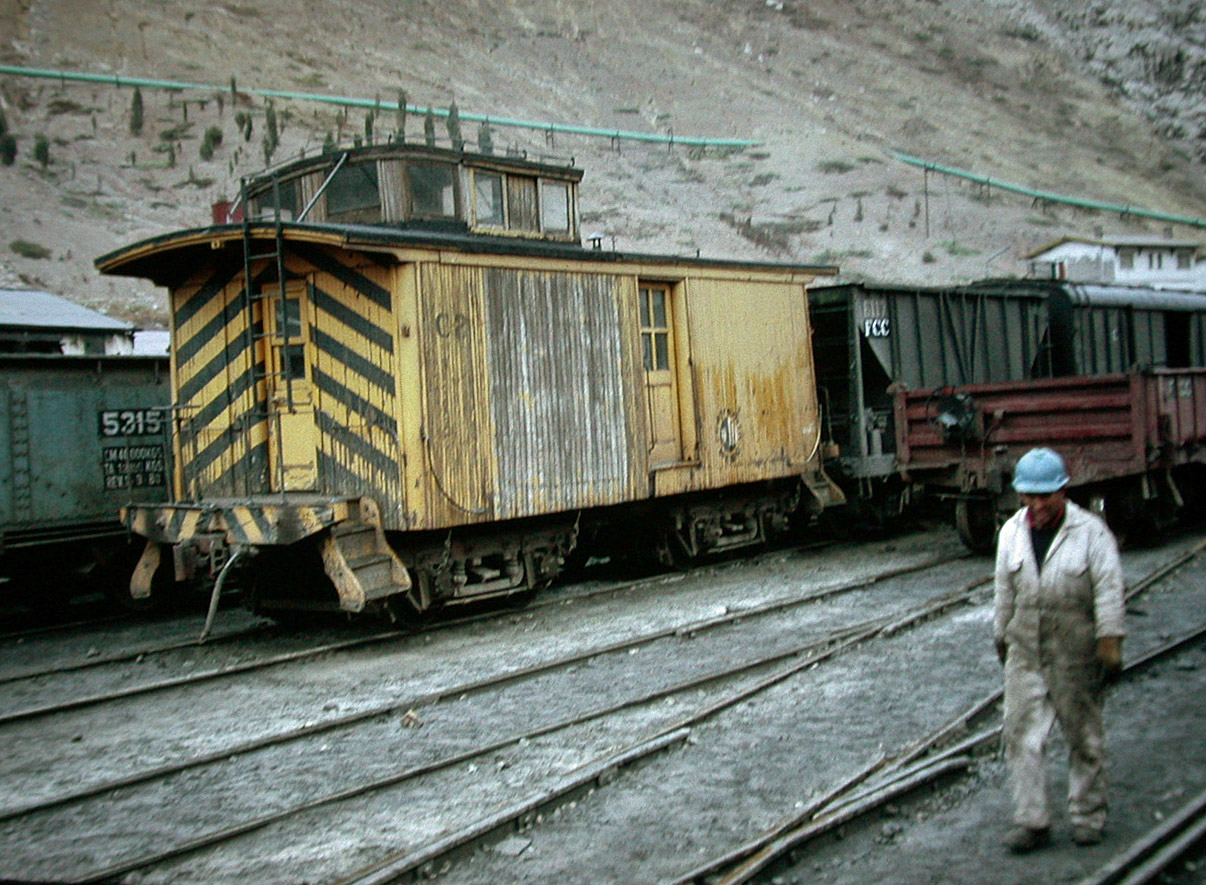 La Oroya
We added some gondola cars to the front of the train. These helped to reduce the fumes but gave us a great deal of slack action as the train was now running downhill with the cars bunched up. The gondolas were dropped off at Llocllapampa which looks almost Welsh. We jdescended gradually, now in the dark, to Huancayo which is at 10,725 ft. There is now only about one train a month on this section and we made good time. There were a lot of people waiting to greet us at the station. I stepped down to shouts of “Welcome to Huancayo” and into the glare of TV lights and flashlights. The local chamber of trade was making the most of our visit to persuade the government to reinstate the passenger train. We disengaged ourselves from the hugs of the local ambassadors to keep an eye on our bags although I thought any potential thieves would have been lynched by the locals, so happy were they to see us. Buses quickly took us to the hotel and Bill and I decided we needed something to eat. One of the ambassadors told me that we would not be able to find cuy in the evening but only for lunch. We walked out and almost straight away found a restaurant advertising cuy con salsa mani. Maybe it was left over from lunch. They were about to close, but, as this was the most expensive thing on the menu, the owner seemed pleased to servve us. So now I have eaten guinea pig cuy picante.This is a specialty of this part of the Andes but the sauce, with peanuts and chili is only prepared in this valley. It took some time to figure out that “mani” is the Latin American word for “peanut”, the more common word being “cacahuete. The meat was good but a little fatty and the sauce was very rich. Of course the anatomy was different from anything I have ever experienced before. The plate came with rice and potatoes and with a very large beer the meal cost $3.75.
I
breathlessly climbed the three flights of stairs to our room,
determines not to use the elevator, and fell into bed.
Halftime score: Colin - 1 cuy - 0
|