|
Click here to see all pictures taken in 1994 In 1994 I was asked by the government in Buenos Aires to go down at their expense and spend two weeks giving meetings and presentations about government regulation of railway safety. The railway system was being privatized and government was wondering what steps it should take to ensure that the railways operated safely. I went down for a period of two full weeks with three weekends. The arrangement I had was that I would be available for two weeks of five week days and they would show me their system, with one of their experienced inspectors for three weekends. Saturday 16 April I arrived
on Aerolinas Argentina on schedule at 6:30 and was quickly through
customs and immigration. I had had a pretty good night's sleep and
could enjoy the early morning sights as I went downtown in the van
provided by the Hotel Nogaro. The room was not great but
everything seemed to work and it was clean. I subsequently found out
two annoyances. The bathtub needed caulking and there was no way I
could have a shower without flooding the floor. Also the hotel is
close to the Plaza de Mayo and the clock strikes every quarter of an
hour right through the night. One advantage was that I did not need a
wake-up call. I had a shower and a short lie down and was met by Julio Castro from the Secretariat at 10:00. He gave me a
quick briefing and then we went to the Retiro station where we
met the superintendent who accompanied us on our trip. Retiro station
is beautiful with a great deal of stonework. The main hall is high
but the feeling is spoilt by the vast number of stalls and shops that
clutter the concourse. The train shed is a semi-circular glass and
steel structure similar to St. Pancras in london. It has obviously
seen better days and is badly in need of cleaning and repair. These
buildings were the cathedrals of the early 20th century. My
first ride was, ominously, curtailed by a derailment. We had intended
to ride on the Mitre line to Tigre but only went as far as
Jose Luis Suarez. The broad gauge (5ft 6in) electric
multiple unit had no speedometer, at least it was broken. The deadman
pedal seemed to function although the driver negated this by
placing the reverse into idle when coasting into stations. The
signaling system is electric block with semaphore signals and some
automatic
block sections. The third rail has underside pickup and many of the
protective boards were missing which would constitute a serious
safety hazard. There are many crossings in the suburban
area and a large number are protected by barriers operated, in the
large part, manually. Some of these cover the full road surface while
others only close over part of the road surface - I was not sure
whether by accident or design. The track was jointed with staggered
joints. The flat bottom rail was secured to the ties through a chair
fastened by a nut and bolt although large lag screws were also used.
Point work was all mechanical with local interlockings and I noticed point locks on facing points only on the double track.
There is an excellent maintenance shed at Jose Luis Suarez and we stayed on the train to return to V Ballester where we caught a diesel to Escobar. Somehow a dog managed to get into the train at Suarez and we had some difficulty in keeping him out of the driving compartment. The diesel, D604, has been built by Breda but was re-engined by Alco. It rocked and rolled a bit but was remarkably quiet even in the seventh throttle position. Both windshields were cracked and, of course, the speedometer did not work. The unit was running long hood forward. This is accomplished in the cab by the simple expedient of changing the position of the kitchen chairs that are provided for the crews.
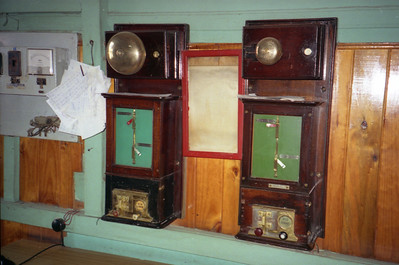
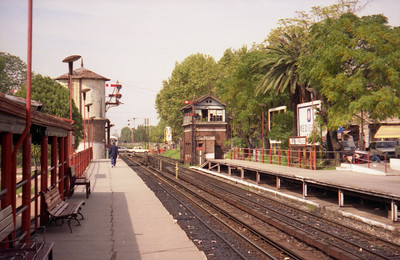
Escobar is a pleasant country station. We had a look at the block telegraph system and I examined the train register. I noticed
the station agents do not bother to use "call attention" (One Beat) even though the rules say they should. The
telegraph instruments and bells are lovely ancient things that are as
much works of art as working machinery. The lever frame was outside
on the platform open to the elements. Lunch was taken at a parilla " La Terminal" which is right next to the station. Sr.
Castro is quite a gourmet and quickly took charge by ordering a
parrillada (mixed grill) and a bottle of red wine. The
parrillada contained a variety of poorer cuts of meat and included intestines as
well as udder. The latter is a little tough and I would not recommend
it. The superintendent said he preferred it uncooked. The meal was
accompanied by a great plate of heavily salted french fries and a
token salad which consisted mainly of pungent onions.
From Escobar we took a short bus ride to Mattheu which is on
another line, single track, for our return to Buenos Aires. The
diesel was a little late and we had a chance to examine the ties
which are made of quebracho wood. This is incredibly strong and
hard and has lasted for at least 80 years. D504 was a diesel rail car
with a trailer. The conductor rode in the small baggage compartment
just behind the driving cab. The train was very full and seemed to
lumber through the overgrown rails. The transmission was hydraulic
with manual gear selection. The speedometer was operational in the
sense that it was intact and had a pointer that moved as speed
increased but it was wildly inaccurate, particularly when changing
gear. It was Saturday afternoon and everyone was out playing soccer
and drinking mate. There were many dirt roads in the area and many
signs of trespassing along the overgrown right of way. In some cases
the token system was out of order and so a paper authority was given
instead of the token.
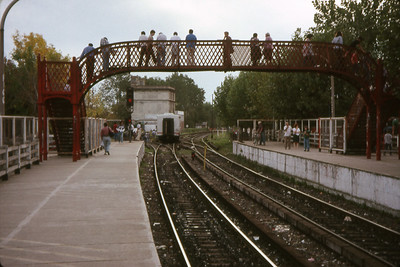
We changed to an electric multiple unit at the site of the derailment which they were just clearing up. It was at a junction close to an overbridge which provided a grandstand view for many onlookers. Again the speedometer had been smashed on the multiple unit. The trip back to Retiro was uneventful in the gathering gloom and I caught a taxi back to the hotel.
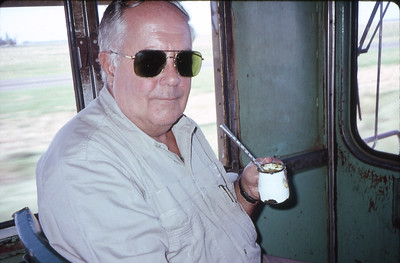
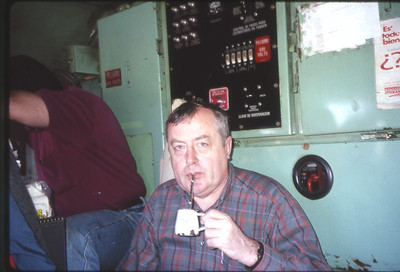
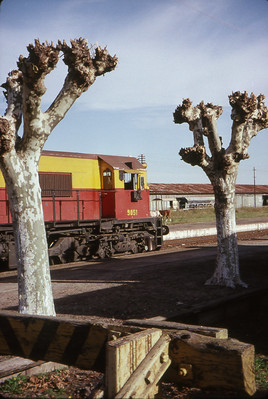
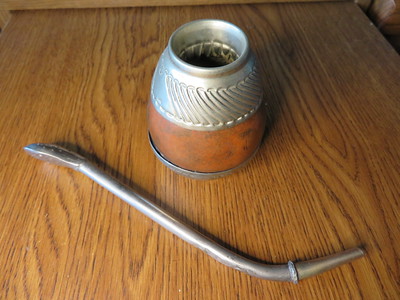
Sunday 17 April It seemed like a short night as I was back at Constitution station at 7:15 this morning. This is another beautiful building that has been ruined by a plethora of stands in The concourse as well as many years of neglect. The train shed is not as impressive as Retiro. Today we took the main line train to Mar del Plata. This is the main passenger corridor with several trains making the 400 km journey daily. The passenger cars were premium first but there were many broken windows. The unit was 9075, a GM, 2400 HP locomotive with three axle trucks. We were accompanied by an inspector and so three kitchen chairs were brought into the cab for us. There was an open newspaper in the cab. We left on time and it quickly became evident that 9075 pulled well, was quite quiet and gave a good ride. The first order of business was to see to the mate. I had wondered why the stove was going full tilt when I got in! A small kettle is used to heat the water to just below boiling point. This is quite an art and the host has to keep feeling the kettle and moving it on and off of the stove. They used a small enamel cup with a handle although some crews use the more traditional gourd. The cup is filled to the top with gerber and the hot water poured over. The host takes the first sip from the silver drinking tube and, if he is satisfied that the water is right, he will then offer it to everyone else in turn. Each person drains the cup, the tube contains a filter in the bulb, and returns it to the host without comment. This is not quite as simple as it may seem. The metal tube conducts the heat well and one must avoid burning one's lips. In addition there is the motion of the locomotive to watch out for. I had visions of punching a small round hole through my lip against my teeth, knocking out a tooth or driving the tubes through the back of my throat - and all for a couple of sips of a bitter tasting liquid. The cup is passed around continually, when one has had enough one says “muchas gracias” which indicates that you are finished. All this was accompanied with sticky buns and croissants.
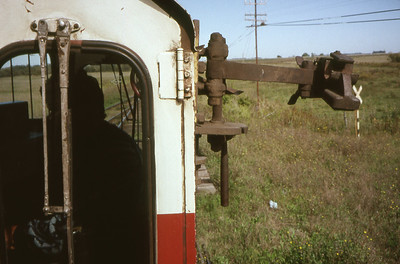
Again there were many crossings on this line with a number for pedestrians only and fitted with maze barriers. There were many crossing keepers, all with the green flag which they waved to the train to signify that they had stopped the traffic. Again the speedometer was not working which is a problem at higher speeds (I timed us at 134 kph at one time) and the dead man pedal was held down with a brake shoe. Away from Buenos Aires we entered single line territory controlled with the electric tokens. This was the first time I have seen automatic token exchange. The token is placed in its carrier in the apparatus on the outside of the locomotive above and behind the cab window. The driver closes his window afterwards. We approached the exchange apparatus at 120 kph and the exchange was carried out with a loud thunk. It is quite a thrill. The token dropped on one occasion and we had to stop and go back to retrieve it.
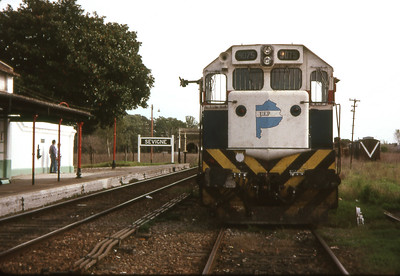
The countryside was very flat and was mainly cattle. There was a great deal of water in the low-lying areas and there were many wading birds. We took the siding at Sevigne, ostensibly to make a meet with 9079 on a passenger train but in fact to make room for more matte. I stood behind the engineer on the next part of the trip and began to wish that I had not done so as the speedometer did not work and the dead man pedal was held down with the brake shoe while the noise from the token exchange was deafening. We took on more water for mate at Sylvania which was a bit of a mistake as the drinking water here is from a well and is quite brackish. More flat land with pampas grass in places and there was a meet with the second train hauled by 9083 just before we arrived in Mar del Plata. We had a meeting with the superintendent, Hector Barros, who now works for the province of Buenos Aires which has taken over the service until a buyer can be found, and then went to the seashore to have lunch at El Viejo. This was an excellent seafood restaurant where we had octopus and shrimp washed down with another excellent bottle of wine. There was time for a quick walk and then we took a taxi back to the main front by the casino and then back to the station for the 18.00 departure for Buenos Aires. None of the signals have lamps but they are easily seen through the high visibility reflective strips on the semaphore arms. Our locomotive was 9072 and we were hauling a train of Budd build cars which were bought second hand about 1956. This time we had mate flavored with cedron. The return was in the dark which made the sensation of speed even greater - I clocked one km at 25 seconds which is about 144 kmph. The reflective material on the signal arms was very effective and there was no need for lamps. Both drivers left the engine to have a leak off the platform of the locomotive. It was a long day and I arrived back at the hotel around midnight.
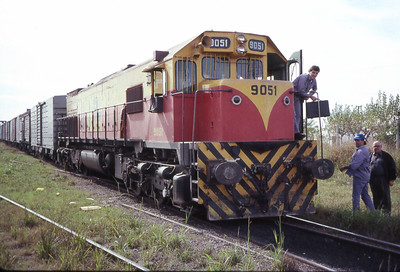
Saturday 23 April Today I went to Olavarria by freight train on the Ferrosur Roca Railway which is one of the new ones established about a year ago to operate regional freight service. Before leaving I bought a bag of empanadas which came in useful. Sr. Castro met me at the hotel and we took a remise to kilo cinco. This is in a less salubrious part of town. There was some discussion with the driver and we actually passed our train a couple of times before we found the yard office. Conductor Mondini and engineer Castro were waiting for us and had two kitchen chairs in the cab ready for us. The crews rotate duties and the conductor goes off duty five minutes before the engineer so that he will be engineer on his next trip. The two were quite young and enthusiastic. Our unit was 9051, a GM 2400 HP 6 axle unit purchased by Ferrosur Roca and there was plenty of power for the 40 car train weighing 924 tons. In fact for this type of operation a less powerful 1750 HP unit would suffice. We left at 12:38 for the first part of the trip over FEMESA territory, which was along the four track main line as far as Temperley. The dead man pedal was operative as was the speedometer which was placed in the middle of the cab above the window where everyone could see it. There are many crossings in the Buenos Aires area and I saw a truck drive around the gates at one of them. Temperley is a major junction and we had to cross the entire layout in order to get to the line to Ezeiza which is the end of the suburban service. At Tristan Suarez we passed another Ferosur train hauled by 9045 with another unit running dead. Our first track warrant, taken over the radio, took us from Canuelas to Las Flores and we then stopped at Canuelas for a pull by inspection before entering Ferrosur Roca territory.
The single track was entered at 1400 and it was like entering another world. The land is flat and for the most part, dry. There were isolated settlements surrounded by trees and many of them had wind pumps. This is grassland and there were many cattle although there was some cultivation which was brightened up by fields of bright yellow sunflowers. Along the right of way there were many patches of pampas grass and the railway has let the brush grow on the right of way to the extent that it forms a virtual tunnel in places. There were many patches of water and marshy ground with white geese, wading birds and anhingas, coots and cranes. I saw many gauchos on horseback and there was also some sheep farming. The crew made a note of the passing times for each station. The sidings have been well adapted from the semaphore interlocking. A series of ground frames are now in place but the old semaphores have been retained. The distant signal now performs the function of a mileboard while the home signal shows the position of the switch. This is very good because the crew have a good indication of the position of each switch from a long way away. Mate was taken accompanied by sticky buns and my empanadas. This time the crew used a real mate made from a small gourd. I took the opportunity of our stop at Flores to examine the fine station while the conductor walked the train to give it an examination. The roller bearings were all running cool and no problems were found. In many cases the old vacuum brake equipment is still in place although the air brake is used exclusively now.
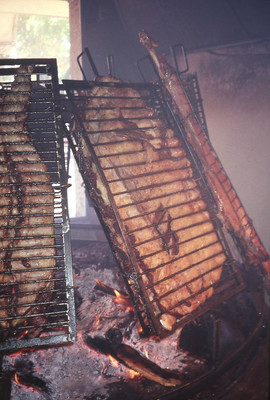
The trip to Shaw was over the flat pampas and we took the siding for a meet with 9003 with 9001 dead. The roads in this area were all dirt and the occasional dusty village provided me with plenty of interest watching the people, many on horseback. It began to get dark and we could enjoy the sunset. We arrived at Olavarria around 20:30 and were met by the superintendent, Gustavo Romero, who took us into the office to show us the operation. The CN style CAMBS system of computer train control was used. I was amused that the controller has the ability to issue an authority for a snow plow extra. Wayne Metcalfe, whom I had known from CN in my grain days, came down to the office and we greeted each other like long lost friends. He is doing well and the railway is thriving. We had a good dinner, the wine was exceptionally good - Clos du Moulin, with Wayne. I got to bed around midnight. Sunday 24 April Another short night, or so it seemed. There was no return train leaving at a convenient time so we decided to catch the 1300 bus back to Buenos Aires. After breakfast we had a walk around the town and stopped in to look at a parrilla. There is a wood fire in the middle and the meat is placed on a conical steel grid between two frames. There was chicken, suckling pig, lamb and beef as well as chorizos cooking on a separate barbecue.
There are a number of interesting period buildings in the town, particularly the banks. Very ornate with several statues. We had an early lunch of ravioli with Gustavo Romero and then to the bus station for a return. Nothing special to report except a couple in the backseat who drank mate using water from a vacuum flask. The bus developed a flat tire in Buenos Aires quite close to the hotel so I was spared the expense of a taxi back from the Retiro bus station.
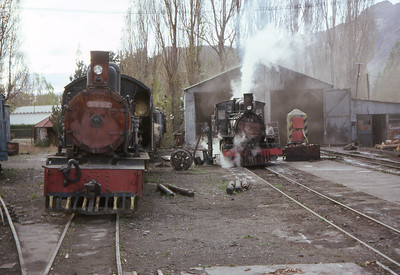
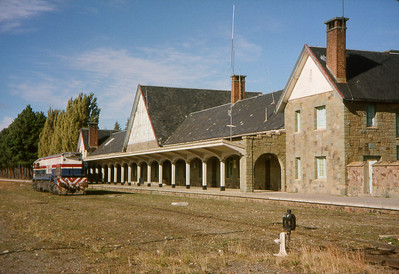
Friday 29 April A few days earlier in the week I was asked where I would like to go for my last weekend in Argentina. I jokingly mentioned El Maiten but I felt this was maybe too far and suggested a couple of places a little closer to Buenos Aires. On Friday afternoon I was told it's about time you got off to the airport for your trip to Bariloche. We flew in an Aerolinas Argentinas 727. It was not a good flight and we had the hardest landing I have ever experienced. We hired a car and found a hotel in the town. It was dark but Julio assured me that the view of the lake was very good. We found a restaurant and had locro which is a type of stew with corn, beans, ham, beef, pork and intestines. It was explained that we would be visiting the narrow gauge railway but because it only ran on Thursdays nothing would be in steam or operational. Saturday 30 April After an early breakfast we set off for El Maiten and la trenchita. The weather in the mountains was not too good and it rained all the time we were in the mountains. The fall colors were interesting although not as spectacular as Ontario or Quebec. The poplars were a bright yellow which provided a good contrast with the evergreens. There were many notros trees as well as nirac which have horizontal branches and hanging moss. The road gradually deteriorated but the surface was not too bad being firm and rocky if uneven. There was only one soft part and this was where we came across a truck that had stalled with its trailer stuck in the soft shoulder. We found the turning off to El Maiten and as we climbed through the mountains the land quickly became drier so that we were going through a high, wide, dry valley with outcroppings of rock on each side. El Maiten was larger than I had imagined. It is a town with wide dirt streets and it was surprisingly difficult to find the railway station. We met Sr. Quiroga, the superintendent and he took us for a tour of the workshop. There were four operating steam locomotives, two Baldwins and two Henschels. They carry out complete repairs at El Maiten, including boiler retubing and firebox patching. There is a lot of work done on the wooden passenger cars as well. They are completely independent in terms of repair and rebuild capability. Although no trains were scheduled I was surprised to find there was one locomotive in steam.
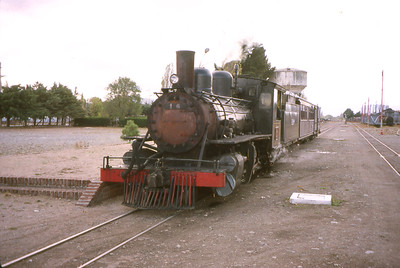
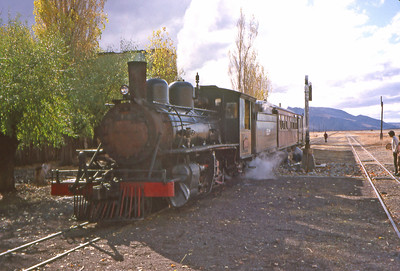
We were taken to lunch at a parrilla. The ribs were excellent as was the wine. This was a simple country place with just two long tables. They were nicely set out and the salad was very attractively arranged. All the senior railway staff were there and we had a very pleasant time. Upon arrival back at the station a two-car train was waiting for us with Baldwin number 16 ready to take us on a trip to Leleque. The superintendent said to me “This is your train where would you like to ride?” I decided to ride the engine for the first part of the trip. I found the fall plate between engine and tender to be quite slippery. It was explained to the crew that I had been a fireman on steam and I was ushered into the fireman's seat. My first action on the firing handle put the fire out. I got the fire relit and then my second movement nearly blacked the fire out completely. I could feel several pairs of eyes watching me but I had by now established the parameters and found that number 16 fired well against the stack. I kept the steam pressure around 125 pounds which was well below the 150 lb blowing off point but the engine went well at this pressure and there was no danger of blowing off. The water was kept very low in the glass, much lower than I would have liked. The injector operation was strange to me but it kept the water level where the fireman wanted it so that was all that mattered.
El Maiten I quickly became at ease and could enjoy the scenery from the fireman's seat of la trochita or the Old Patagonian Express. We ran through a wide flat valley with low hills on either side. This is open semi desert and the only trees were around the odd isolated settlements. Many of these were popular used as wind brakes. There were some sheep grazing on the sparse grass and the only other life seemed to be the odd hare that would break from cover and run away from the train. The narrow gauge (75 cm) track was generally straight with only the odd curve. The rails were covered in places with grass. The engine was dirty and looked uncared for but it appeared to be very well maintained. As we approached Leleque the fireman sanded the flues. He dropped a fair amount of sand on the floor and did not even bother to sweep it up so it just blew around.
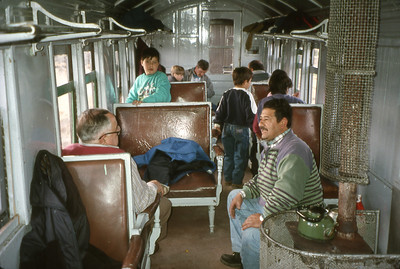
Leleque Leleque is an isolated settlement which contains a siding, a water tank and a small hut which serves as a station office complete with morse telegraph for train orders. The crew took water and ran around the train. They were careful to couple the vacuum brake pipes but there was nothing showing on the gauge in the locomotive and I didn't feel the brakes being blown off. I assume we were running without brakes. I came back to El Maiten in the passenger car. This was toasty warm from the wood stove and we had mate to complete the day. The only other passengers were the numerous boisterous children of the railway employees. This was a good way for them to spend a Saturday afternoon. I only had one Operation Lifesaver pin left and gave this, at Leleque, to a little kid who was about six. He had a poncho and his mother had wrapped a scarf well around his neck. He came up to me at El Maiten and asked if I really meant that he should have it. I pinned it to his shirt.
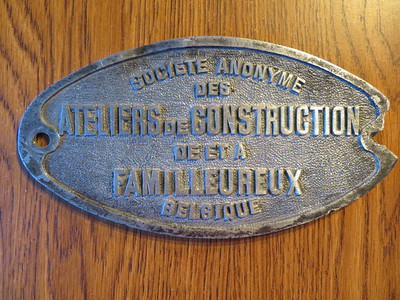
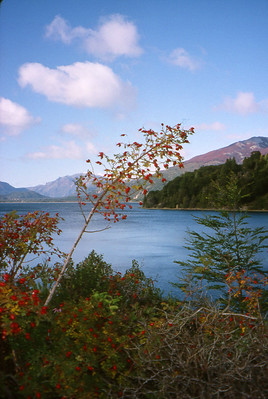
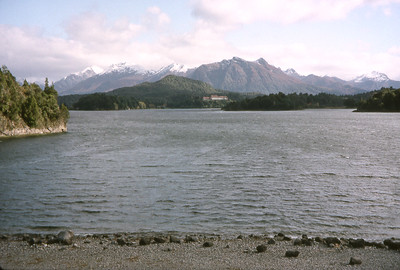
As we were leaving El Maiten I was presented with this souvenir - from one of the passenger cars I said to goodbye to the crew and we drove back to Bariloche. This time we went through El Bolson which gave us a fine view of the desert before night fell. We passed several people on horseback. They were all wearing ponchos and hats and were well wrapped up against the winter cold and the odd rain shower. Passing El Bolson we entered the mountains and it began to rain continuously. The trip back was uneventful until we hit a large rock which bent the wheel rim sufficiently that we lost air from the tire. We stopped at a heavy equipment compound where we hammered the rim back into shape and then changed the tire. The night watchman came out to help us in the pouring rain naked to the waist. It only took about half an hour and we were quickly on our way. Sunday 1 May We had the luxury of getting up late this morning as this was a free day. We had a leisurely breakfast and drove around the Bariloche area. The mountains are well worth a visit and the fall colors provided some good contrasts. We went to a parrilla for lunch and ordered lamb (cordero). Like most restaurants in Argentina, the wine bottles were displayed on a narrow shelf on each wall. This makes it easy to select and the customer can quickly find out if a particular brand is available. We had a look at the station in the afternoon. There was one locomotive, 9070 which would take the evening train back to Buenos Aires. The area to the east of Bariloche is very interesting in that it is dessert and very typical Patagonian scenery. We had a final parilla for dinner. This consisted of sweetbreads, brains, intestines, tripe, chorizo (two types), thin pork sausage, kidney and meat. This was too much for us and we had to leave some.
Monday 2 May Again there was the opportunity to get up late. We looked at the Bariloche town center and the well laid out museum. I then purchased some smoked salmon, trout, venison and pork and it was time to get out to the airport for a much smoother flight back to Buenos Aires. I took a taxi into the Hotel Nogado where I had reserved a day room in preparation for my flight back to Ottawa. Some final business was conducted with Carl Knechtel at the Secretariat and then I had lunch with the deputy minister of transport. This was extremely pleasant and I was dumbfounded when he asked me if I would be prepared to come down to Buenos Aires permanently and run the railway safety program. This was the end to an exhausting but interesting trip but my mind was in turmoil all the way back to Ottawa.
Souvenirs of the trip
|